
All work

Build · Mobile car detailing

The detailing business that stopped running on memory.

Cloud 9 Car Detailing sold one way, by knocking on doors, and tracked everything that happened afterwards on paper. It was rebuilt as a system: a site that sells only real availability, a CRM with dated follow-ups, and attribution that connects tracked campaigns to bookings.

Industry
Home & car services
Market
Southlake & Westlake, TX
Scope
Site · Booking · CRM · Attribution
Status
Live
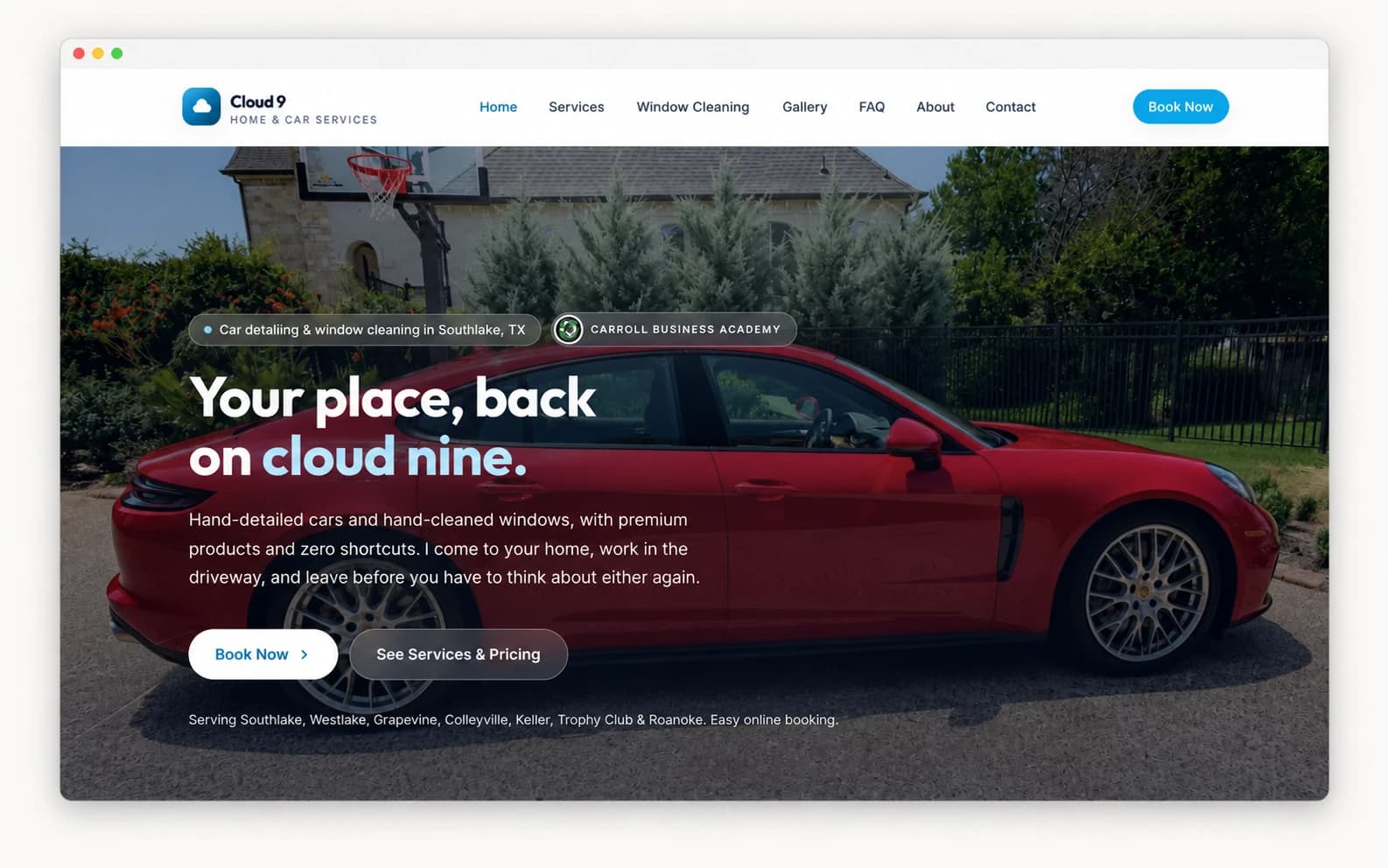
Cloud 9 Home and Car Services website with a booking call to action and a red car photographed on a driveway

The live site. cloud9cardetailing.com

Before

A real business held together by hand.

None of this was laziness. It is what running a service business alone looks like before anyone builds you the machinery: the work gets done, and everything around the work gets dropped.

  • One channel, and it was somebody's feet

    Every customer came from knocking on a door. Nothing arrived on its own: no inbound enquiries, no bookings overnight, no way for a stranger who wanted the service to find it.

  • The customer list was a memory

    Names, vehicles, quotes and promises lived on paper and in the operator's head. Two conversations on the same street could blur into one by the end of a route.

  • Follow-ups died quietly

    Someone who said “not this week” was rarely contacted again. Not as a decision, just as a consequence of nobody holding the list. The most winnable customers were the ones being lost.

  • The website cost trust instead of earning it

    The site that existed made a real business look like a side hustle, at the exact moment a homeowner was deciding whether to let a stranger work on their car.

  • Nothing was measured

    No way to tell which effort produced which customer. That makes spending money on marketing an act of faith: you cannot double down on what you cannot see.

What was built

The parts a person keeps forgetting.

Six systems, one operator. Each replaces something that used to live in somebody's head, and each keeps working on the days nobody is available to run it.

A booking engine that only sells time that exists

Pricing by vehicle size, packages and add-ons, per-day job caps, blackout dates, and availability driven by real working windows. Every rule is validated on the server, so a stale page cannot sell a slot that is not there.

Lead capture that answers before you do

Every enquiry from the site writes straight into the database and gets an immediate reply. Nobody waits on a text the operator meant to send after the next job and forgot.

The CRM that replaced the notebook

Every customer and every lead, with its source, its history and a dated next action. Built to be opened on a phone in a driveway between jobs, not a desktop tool that only gets used on Sunday night.

Attribution wired end to end

Tracking on every page, UTM tagging on every paid destination, and a booking event that carries its own value. A booking can be traced back to the specific ad that caused it.

Paid acquisition infrastructure

Campaign structure, targeting tight enough to only reach people inside the service area, and a form-to-booking handoff that turns an ad click into a confirmed appointment without a phone call.

A written decision log

Every pricing change, offer and campaign recorded with what was tried, what it cost, and what happened. A small business's most expensive habit is re-running an experiment it already failed.

What changed

Booking no longer waits for a reply.

A stranger saw an ad at half past nine on a weeknight, filled in a form, and had a confirmed, priced appointment 106 seconds later.

One captured booking event. This is not an average or a guarantee of future performance.

The business works while the operator doesn't

Bookings complete overnight, mid-job, any time a customer is ready rather than any time somebody is free to answer.

Nothing depends on remembering

Follow-ups have dates attached and sit in one place. The system holds the list, so a busy week stops silently costing customers.

The calendar tells the truth

Published availability is the availability that exists, capped at what one operator can actually deliver in a day. No apology bookings, no double-booked afternoons.

Marketing became a decision, not a hope

With attribution in place, spend can be judged on what it produced and cut when it does not. Every channel is accountable to the same number.

The build

Custom, because the rules are the business.

Off-the-shelf booking software would have sold slots this business cannot deliver, and no template CRM knows what a door-knocked lead is. The constraints - one operator, a hard daily job cap, pricing that turns on vehicle size, availability that moves week to week - are exactly the parts a generic tool gets wrong. So they were built, not configured.

Build this for my business
Application
Next.js, deployed on Vercel
Data
Postgres: bookings, leads, customers
Rules
Capacity, pricing and promotions validated server-side
Comms
Transactional confirmation and instant lead reply
Measurement
Site-wide tracking, UTM tagging, valued booking events
Operator tooling
Private dashboard: customers, leads, dated follow-ups
Ownership
The code, the data and the domain belong to the business

Next step

Tell me what part of the week keeps breaking.

Thirty minutes, no pitch. If it is cheaper to live with than to fix, you get told that. Based in Southlake, so an in-person visit is on the table.